GRAPHIC ORGANIZER
A graphic organizer is an instructional tool used to illustrate a student or class's prior knowledge about a topic or section of text; specific examples include the K-W-L-H Technique and the Anticipation/Reaction Guide. Other organizers include the:
Spider Map

Used to describe a central idea: a thing (a geographic region), process (meiosis), concept (altruism), or proposition with support (experimental drugs should be available to AIDS victims). Key frame questions: What is the central idea? What are its attributes? What are its functions?
Series of Events Chain
Used to describe the stages of something (the life cycle of a primate); the steps in a linear procedure (how to neutralize an acid); a sequence of events (how feudalism led to the formation of nation states); or the goals, actions, and outcomes of a historical figure or character in a novel (the rise and fall of Napoleon). Key frame questions: What is the object, procedure, or initiating event? What are the stages or steps? How do they lead to one another? What is the final outcome?
Continuum Scale
Used for time lines showing historical events or ages (grade levels in school), degrees of something (weight), shades of meaning (Likert scales), or ratings scales (achievement in school). Key frame questions: What is being scaled? What are the end points?
Compare/Contrast Matrix
| Name 1 | Name 2 |
| Attribute 1 |
|
|
| Attribute 2 |
|
|
| Attribute 3 |
|
|
Used to show similarities and differences between two things (people, places, events, ideas, etc.). Key frame question: What things are being compared? How are they similar? How are they different?
Problem/Solution Outline
Used to represent a problem, attempted solutions, and results (the national debt). Key frame questions: What was the problem? Who had the problem? Why was it a problem? What attempts were made to solve the problem? Did those attempts succeed?
Network Tree
Used to show causal information (causes of poverty), a hierarchy (types of insects), or branching procedures (the circulatory system). Key frame questions: What is the superordinate category? What are the subordinate categories? How are they related? How many levels are there?
Human Interaction Outline
Used to show the nature of an interaction between persons or groups (Europeans settlers and American Indians). Key frame questions: Who are the persons or groups? What were their goals? Did they conflict or cooperate? What was the outcome for each person or group?
Fishbone Map
Used to show the causal interaction of a complex event (an election, a nuclear explosion) or complex phenomenon (juvenile delinquency, learning disabilities). Key frame questions: What are the factors that cause X ? How do they interrelate? Are the factors that cause X the same as those that cause X to persist?
Cycle
Graphic Organizers
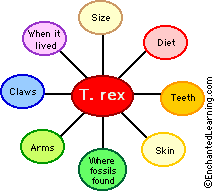 Graphic organizers (some of which are also called concept maps, entity relationship charts, and mind maps) are a pictorial way of constructing knowledge and organizing information. They help the student convert and compress a lot of seemingly disjointed information into a structured, simple-to-read, graphic display. The resulting visual display conveys complex information in a simple-to-understand manner.
Increasing Understanding by Creating Graphic Organizers:
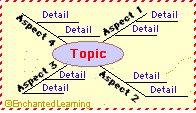 The process of converting a mass of data/information/ideas into a graphic map gives the student an increased understanding and insight into the topic at hand. To create the map, the student must concentrate on the relationships between the items and examine the meanings attached to each of them. While creating a map, the student must also prioritize the information, determining which parts of the material are the most important and should be focused upon, and where each item should be placed in the map.
 The creation of graphic organizers also helps the student generate ideas as they develop and note their thoughts visually. The possibilities associated with a topic become clearer as the student's ideas are classified visually.
Uses of Graphic Organizers:
Graphic organizers can be used to structure writing projects, to help in problem solving, decision making, studying, planning research and brainstorming.
 Creating Graphic Organizers:
 Graphic organizers can be drawn free-hand or printed. To go to printouts of many graphic organizers, click on one of the links above or below.
Adding color-coding and/or pictures to a graphic organizer further increases the utility and readability of the visual display.
How to Choose a Graphic Organizer for Your Topic/Task (click on a graphic organizer below to go to printable worksheets):
The task at hand determines the type of graphic organizer that is appropriate. The following is a list of common graphic organizers - choose the format that best fits your topic.
 Star: If the topic involves investigating attributes associated with a single topic, use a star diagram as your graphic organizer. Example: Finding methods that help your study skills (like taking notes, reading, doing homework, memorizing, etc.).
 Spider: If the topic involves investigating attributes associated with a single topic, and then obtaining more details on each of these ideas, use a spider diagram as your graphic organizer. This is like the star graphic organizer with one more level of detail. Example: Finding methods that help your study skills (like taking notes, reading, memorizing, etc.), and investigating the factors involved in performing each of the methods.
 Fishbone: If the topic involves investigating multiple cause-and-effect factors associated with a complex topic and how they inter-relate, use a fishbone diagram as your graphic organizer. Example: Examining the effects of improved farming methods.
 Cloud/Cluster: If the topic involves generating a web of ideas based on a stimulus topic, use a clustering diagram as your graphic organizer. Example: brainstorming.
 Tree: If the topic involves a chain of events with a beginning and with multiple outcomes at each node (like a family tree), use a tree as your graphic organizer. Example: Displaying the probabilistic results of tossing coins.
 Chain of Events: If the topic involves a linear chain of events, with a definite beginning, middle, and end, use a chain of events graphic organizer. Example: Analyzing the plot of a story.
 Continuum/Timeline: If the topic has definite beginning and ending points, and a number of divisions or sequences in between, use a continuum/timeline. Example: Displaying milestones in a person's life.
 Clock: If the topic involves a clock-like cycle, use a clock graphic organizer. Example topic: Recording the events in a typical school day or making a story clock to summarize a story.
 Cycle of Events: If the topic involves a recurring cycle of events, with no beginning and no end, use a cyclic graphic organizer. Example topic: Documenting the stages in the lifecycle of an animal.
 Flowchart: If the topic involves a chain of instructions to follow, with a beginning and multiple possible outcomes at some node, with rules at some nodes, use a flowchart. Example: Computer programmers sometimes use flowcharts to organize the algorithm before writing a program.
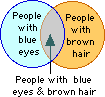
 Venn Diagram: If the task involves examining the similarities and differences between two or three items, use a Venn diagram. Example: Examining the similarities and differences between fish and whales, or comparing a book and the accompanying movie.
 Chart/Matrix Diagram: If the task involves condensing and organizing data about traits of many items, use a chart/matrix. Example: Creating a display of key inventions, who invented them, when, where and why they were invented, etc.
 Y-Chart Diagram: If the task involves analyzing and organizing with respect to three qualities, use a Y-Chart. Example: Fill out a Y-Chart to describe what you know about an animal, including what it looks like, what it sounds like, and what it feels like. Or describe a character in a book, including what the charater looks like, sounds like, and how the charater feels.
 T-Chart Diagram: If the task involves analyzing or comparing with two aspects of the topic, use a T-Chart. Example: Fill out a T-Chart to evaluate the pros and cons associated with a decision.
 Fact/Opinion: If the task involves distinguishing the facts vs. the opinions in a theme or text, use fact/opinion charts. Example: Fill out a fact/opinion chart to evaluate the facts and opinions presented in a news article.
 PMI Diagram: If the task involves analyzing the plusses, minuses, and implicatios of a decision or an action, use a PMI Chart. Example: Fill out a PMI Chart to help evaluate the positive, negative and interesting points associated with taking a new job.
 Decision Making Diagrams: If the task is making a decision, use a graphic organizer to enumerate possible alternatives and the pros and cons of each. Example: Fill out a desicion making diagram to help decide which elective courses you'd like to take next quarter.
 Semantic Feature Analysis Charts: If the task is comparing characteristics among a group of items, use Semantic Feature Analysis . Example: Fill out a Semantic Feature Analysis chart to compare and contrast the care needed for various pets.
 Cause and Effect Diagrams: If the task is examining possible causes and effects in a process, use a cause and effect graphic organizer . Example: Fill out a cause-and-effect diagram to trace the steps in a feedback loop..
 KWHL Diagram: If the task involves analyzing and organizing what you know and what you want to learn about a topic, use a KWHL chart. K stands for what you already KNOW about the subject. W stands for what you WANT to learn. H stands for figuring out HOW you can learn more about the topic. L stands for what you LEARN as you read. Example: Fill out a KWHL chart before, during, and after you read about a topic.
 Pie Charts: If the task involves showing divisions with a group, use a pie chart. Example: Draw a pie chart to show what percentages of a population have blue eyes, green eyes, or brown eyes.
 Vocabulary Map: Graphic organizers can be useful in helping a student learn new vocabulary words, having them list the word, its part of speech (noun, verb, adjective, adverb, etc.), a synonym, an antonym, a drawing that represents the word, and a sentence using the word.
 Paragraph Structure: These graphic organizers help you organize the structure of a paragraph, including a topic sentence, sentences with support details, and a conclusion sentence.
 5 W's Diagram: If the task involves analyzing the Five W's (Who, When, Where, What, and Why) of a story or event. Example: Fill out a 5 W's Chart to help evaluate and understand the major points of a newspaper story.
 Story Map: Story maps can help a student summarize, analyze and understand a story or event.
 Character Traits: Graphic organizers help the student identify the traits of fictional characters by looking at events surrounding the character in the text.
 Biography Diagrams: Graphic organizers are useful to help prepare for writing a biography. Before writing, the graphic organizer prompts the student to think about and list the major events in the person's life.
 Animal Report Diagrams: Many graphic organizers are useful to help prepare for writing a report on animals. Before writing, the student should think about and list the major topics that will be researched and covered in the report.
 Geography Report Diagrams: These graphic organizers are useful to for doings a short report on a country or other area. The student draws a map and flag, and looks up basic information on the area.
 Math Diagrams: Many graphic organizers are useful to learn and do math, include Venn diagrams, star diagrams, charts, flowcharts, trees, etc.
Flowchart of How to Choose a Graphic Organizer
To find an appropriate graphic organizer, answer the following questions about your topic:
|


 Scientific Method Diagrams
.jpg)